I'm going to Graceland: LAJ's Elvis pilgrimage
LAJ follows the stars for a pilgrimage to Elvis Presley's legendary home in Memphis, Tennessee.
For reasons I cannot explain. There’s some part of me that wants to see Graceland. And I may be obliged to defend every love, every ending. Or maybe there’s no obligations now. Maybe I’ve a reason to believe we all will be received in Graceland.
Paul Simon, 1986, Sony/ATV Music Publishing
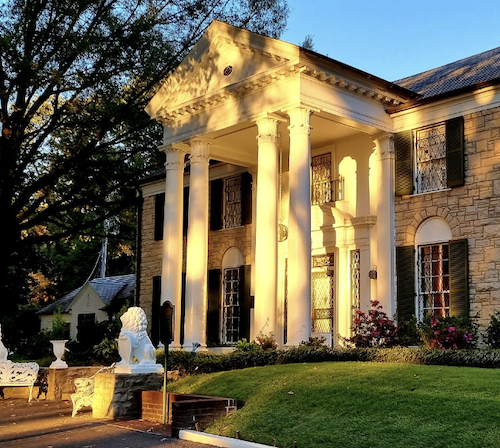
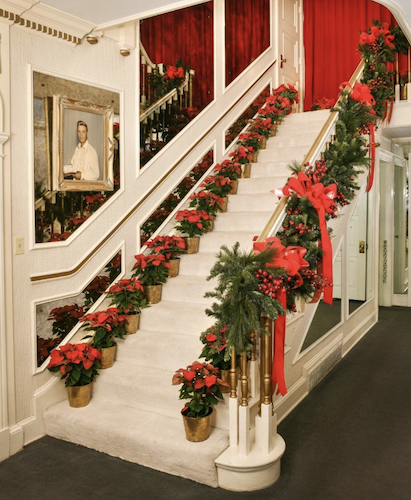
They were decking the halls and tinselling the trees the day we went to Graceland. Because Elvis adored the holidays. The Christmas season there is practically an industry in itself. Not only is the mansion festooned with all the original Presley family decorations, but the entire estate comes to life in an abundance of red velvet drapes and ribbons, twinkling trees and thousands of blue lights along the legendary driveway.
Out on the lawn in front of the house sits Elvis’s beloved old sleigh complete with Santa. They will remain in place, along with the rest of the kitsch and sparkle, all the way to Elvis’s birthday on 8th January.
‘The King’ kicked off this tradition himself, soon into his twenty-year occupancy of the house. His private home has since become a celebrity in its own right. And it has come to represent so much more than the global superstar who lived here.
I had been hearing about it, reading about it and had seen it depicted all those times on screen long before I got to make my own pilgrimage. There is anticipation in the journey, a realisation along with acceptance that a place of such fable and reputation is bound to fall short.
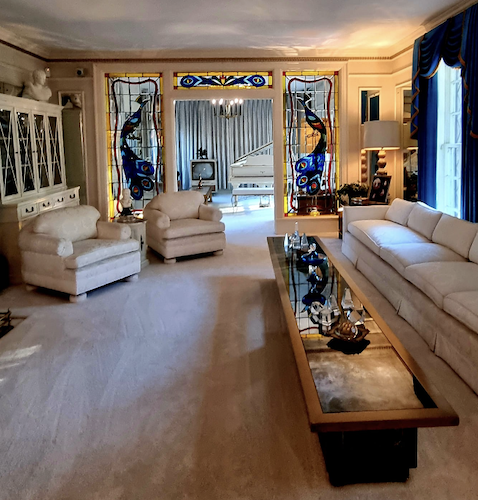
Why? Because no mere Earthly dwelling, however monumental and grand, can live up to the kind of hype that has set Graceland in stone as a shrine to an unforgettable cultural icon. To pass through its famous musical-note gates and wend one’s way towards the imposing white Corinthian columns that guard the entrance is to wind back over almost fifty years as if they never happened. The seventies were then, but look, here they are again: captured and sealed as though in a time warp where Presley’s ghost shifts freely from room to room, and where his spirit feels uneasily alive.
This is poignant: that no visitor may ascend the main staircase, nor step inside the rooms in which Elvis, his wife, his girlfriends and his daughter slept, washed, dressed, read, relaxed and amused themselves. Thus is the inner sanctum preserved, a sacred space through which only those touched personally by the Presley myth and magic were allowed to pass.
You couldn’t call it a stylish house. Not in the ways we interpret the term today. Had Elvis lived, it would have been renovated and upgraded periodically, according to contemporary taste. As it is, it remains just as it was when he lived in it.
You know this living room, this kitchen, this dining room, this sunburst-ceilinged billiard room, this three-TV-set television room, this bar, this den. You have seen them in the movies, whether as film-set reconstructions or on location as the real thing. Ugly, shabby and dated now, these rooms, during his lifetime, were the height of curious luxury.
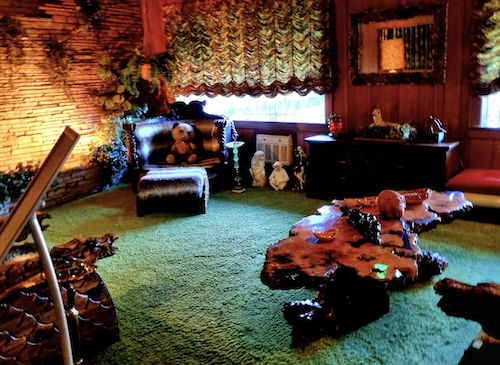
The notorious Jungle Room with its tiki bar furnishings, fake waterfall and coloured lights, scene of the recording of parts of the Moody Blue and From Elvis Presley Boulevard albums. The space where the dead King lay in his open casket, watched over by his nine-year-old daughter who sat curled in an armchair clutching a stuffed toy panda as thousands of mourners filed past. Which would screw you up.
Lisa Marie would marry and divorce four times. She pined for her lost One, Michael Jackson. Her first-ever gig was a performance by Queen at the Inglewood Forum, L.A. Post-show, she gave Freddie Mercury her father’s scarf. She lost her son Benjamin to suicide, and died herself on 12 January 2023, at only fifty-four. She and Benjamin lie together in the Meditation Garden.
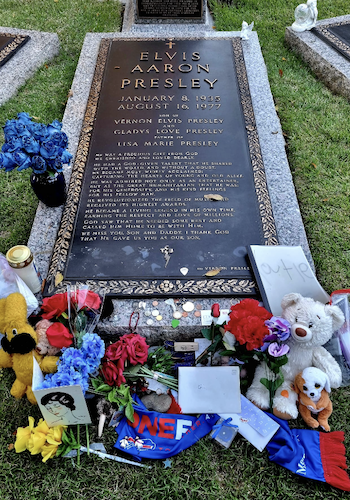
Come his untimely demise at forty-two, Elvis was never less than a mess of contradictions. The King of rock’n’roll and a hopeless addict. A confident, commanding sex symbol and a sag of arrested development. Dependent on the ‘Memphis Mafia’, the gaggle of close friends who pre-dated his fame and whom he kept around to protect, sustain and bleed him dry, he believed that he was guided from the heavens – because the notion had been rammed into him by his mother – by Jesse Presley, his stillborn twin.
We remember that Elvis emerged out of grinding poverty in tornado-prone Tupelo, Mississippi, a backwater among the cottonfields. It occurs to us that Graceland represents how a dirt-poor kid who rose out of hopelessness to thrill the whole world must have imagined how rich people lived.
We step across the terrace, around the kidney-shaped swimming pool slimed with dead leaves and down towards the Meditation Garden. Reality re-emerges among the bones, the shreds. Not only of Elvis but his mother, father and grandmother. His daughter and grandson too. Not even family graves are private here.
Perhaps we are awestruck. Perhaps our silence is really sadness fuelled by raw memories. I recall Jay Gatsby, the doomed protagonist in F. Scott Fitzgerald’s most celebrated novel. He too worked his way up from nothing, on his wits and with talent and flair (albeit on the wrong side of the law) to achieve the nigh-on impossible American Dream. He could buy whatever he wanted except the love of The One.
The Great Gatsby is portrayed as the ultimate party-giver, but was never more alone than when in the midst of one. Similarly, Elvis was isolated by fame, bewildered by the entrapment that arose from it, and coercively controlled by his hustler of a manager, self-styled ‘Colonel’ Tom Parker, who exploited and flogged him towards an early death and gambled away the millions his boy had made.
We should not risk comparison between a fictional character and a flesh-and-blood man? Sure we should. Maybe we must. It is the fiction that enables us to confront and make sense of reality. There’s not too much of that in rock’n’roll, which has always been the problem. In the surreal realm, usual rules rarely apply.
Beyond twilight, out there in the grounds, we board the Lisa Marie. Elvis’s private aircraft, a converted Convair 880 jet liner, is like something out of Austin Powers. Navy shagpile, gold handbasins, dense wooden dining-room-style furniture, a double bed with seatbelts and a funny smell, somewhere between damp and despair. His jackets still hang in the compact closet. The cockpit remains as it was when the plane was last flown.
We wade through aircraft-hangar spaces containing all the King’s automobiles, his costumes, his artefacts. A blur of awards, posters and paperwork. There is endless, fascinating evidence of a life that looks to have been well-lived, but which panned out in pointlessness and concluded with a toilet-seat whimper. I find it almost unbearable to take in.
At the time he expired, Elvis and Priscilla had been divorced for four years. Elvis’s father Vernon and great-grandmother Minnie were still alive. After they died, Lisa Marie became his sole beneficiary, inheriting the lot on her twenty-fifth birthday. Unable to meet the vast maintenance fees of the extensive estate, Priscilla had stewarded Graceland as a tourist destination to make it pay its way.
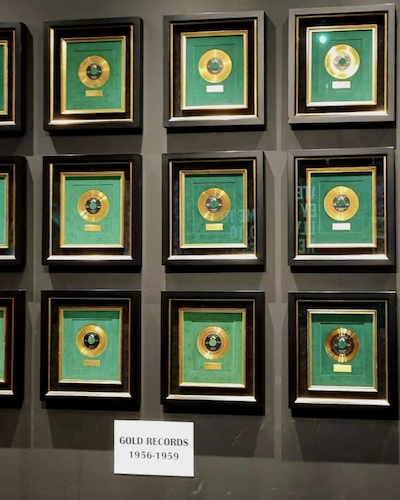
Opened to the public in 1982, it was soon one of America’s most popular attractions, second only to the White House. In May 2016, it welcomed its twenty millionth visitor. Some six hundred thousand people a year had passed through its gates, and the numbers continue to rise.
Among them, legends. Bob Dylan. Bruce Springsteen. Paul McCartney, who deposited a guitar pick on his grave, so that Elvis ‘could play his guitar in heaven.’ Paul Simon was so moved that he wrote the title track of his Graceland album as soon as he got home. President George W. Bush, Albert, Prince of Monaco, our own Royals William and Harry, Beatrice and Eugenie had all stepped this way before us.
What did they make of it? Did they hear the voice? Did they get it? Do they believe that we will all be received in Graceland?
- All images are (c) Lesley-Ann Jones and may not be copied, shared or distributed for either personal or commercial use.