How David Bowie led me out of Bromley
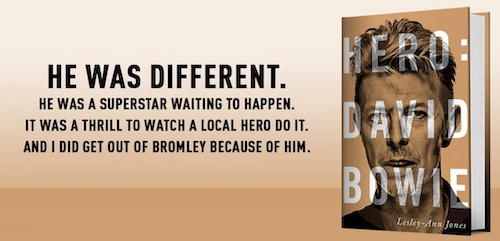
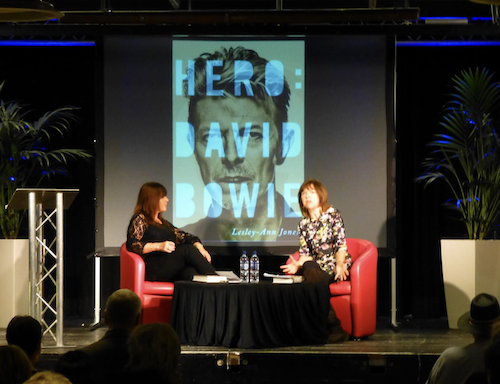
Had he lived, David Bowie would have turned 79 today, 8th January. When he died two days after his birthday in 2016, he was 69. Ten years on, LAJ reflects on her earliest impressions and experiences of him, as documented in her book Hero : David Bowie, published nine months after his death.
Here is TV producer Clare Bramley's review of LAJ's book: ‘News of Bowie’s death knocked every political, financial and human-interest story off the news headlines across the world. The subsequent outpouring of grief, disbelief and manic-obsessive love was as stupefying and disturbing as the man himself. Whether you loved Bowie or loathed him is utterly irrelevant. This book is a deeply personal perspective on the rock and roll years, the participants, the behind-the-scenes craziness, the music and those who were making it. That it is so well-researched, pithy and funny is testament to the author’s honest writing style and desire to share her personal and professional first-hand experiences with her readers. It’s great – Jones gives proper context to the Bowie we knew (or thought we knew) across the decades.’
His original teeth were like tombstones. One eye was luminously blue, the other grey. The right pupil almost eradicated the iris. He was dressed in pink, with a swathe of hair swept sharply back, the other half tousled. He sat surrounded by moody boys and fat-cheeked girls, most of them strumming chipped guitars.
My classmate Lisa's mother, Hy Money, had taken us to the Three Tuns pub on Beckenham High Street one Sunday, where local hero Davie Jones was hosting an Arts Lab music session. Hy, a fine artist and folk singer, worked part-time as a photographer on the Beckenham Record newspaper. She was after some pictures of Vytas Serelis, a renowned sitar player who was giving a recital there that day. Also present was Marc Bolan, then of Tyrannosaurus Rex.
Davie had been friends with ‘Face of ‘68’ teen idol Peter Frampton at Bromley Technical school, where Peter’s father Owen was Head of Art. He had dropped his surname to avoid confusion with Davy Jones, star vocalist of the Monkees, and was making his bid for fame and fortune as a songwriter, singer, guitar player, mime artist … anything, really. He was that desperate to make it.
By the time I got to grammar school, he had changed his name to Bowie and had become a huge star. My friend Natasha and I decided to try and find out where he lived. It didn’t take us long to discover that he was renting a flat in Haddon Hall on Beckenham’s Southend Road.
The huge, red-brick Gothic mansion had mangled balconies, bat-turrets and stained glass, and seemed exactly like the kind of place that he should inhabit. His flatmate was an American called Tony Visconti, who happened to be Bolan’s producer of Marc. We had no idea what a producer even was. Behind our mothers’ backs, we took to hopping the 227 bus to Beckenham after school, on a mission to meet David Bowie and to get his autograph.
He was never at home when we knocked. His American girlfriend Angela usually was. She gave us signed photos and packed us off home. We kept trying. Then one day, she was out.
He answered the door, wearing a grimy yellow silk kimono. He was in the middle of painting his fingernails black, using a cocktail stick for want of a brush. How else to deal with a pair of bowler-hatted pests from a stiff upper girls' school but to invite them in for tea? His vast living room was like Christmas, with bottle-green walls and red velvet sofas. In those surroundings, he was an alien who was out of milk.
We giggled and gushed like idiots. What did we know about reincarnation and Tibet? We read the music rags, we thought we knew everything.
There was no suggestion at the time that he would become one of the most iconic stars in rock history, master of a universe of alter egos, images and recordings unlike any that had gone before. He was just a boy from Brixton who got lucky.
The south London accent and self-conscious hunch never left him. Despite global fame and unimaginable fortune, he was never less nor more than ‘Beckenham David’ to me. I attended his gig at Hammersmith Odeon in July 1973, changing out of my school uniform on the train. To the distress of millions, he retired the Spiders from Mars that night. I didn't see him in person again for another eight years.
Angular, emaciated and androgynous, he was never a heart throb. As students, we sat around on stale rugs intellectualising (we thought) over his lyrics. After college in London and a year in Paris, I drifted into the London music scene.
During a spell of work experience at Capital Radio, I went to Montreux with DJ Roger Scott to interview Freddie Mercury. Queen were recording at their own Mountain Studios on the lip of Lake Geneva. David, who by then was living not far down the road, was there too.
Two years later, I encountered him backstage at the Birmingham NEC. It was the kick-off of his Serious Moonlight European tour, to promote the Let’s Dance album. Now a music writer, I was there to interview him.
The spangled weirdo who had evaporated from the scene five years earlier had metamorphosed into a sex god. Cool, elegant, baby-blonde, and dressed in a classy pale suit, he flashed dazzling new white teeth and exuded brilliance.
‘I was tired of the idea of being a freakish cult figure,' he admitted. ‘I wanted to do something more accessible, more soulful, a bit more R & B, and I’ve been overwhelmed by the response. I didn’t expect this much limelight. I have never performed like this in my life. I feel so much more relaxed, now that I’m not carting some character around. At last, I've learned how to be myself.’
His stormy marriage to Angie was history. David was now involved with his personal assistant, Corinne Schwab. It was obvious that he and ‘Coco’ were lovers, but he didn’t discuss it. Anyway, she was in the room. I stared at the lank-haired woman with the thin, fleshless smile, trying to fathom the attraction.
A band member read my mind.
‘She does everything for him,' he whispered. ‘I mean everything. Ange never did, and it's a revelation to him. David lets Coco do the lot.’
‘She is my good friend,' David later elaborated. ‘She became the most important person in my life in the mid-Seventies when I was a lost boy. My lifestyle at that time made me bonkers. I had a breakdown. Coco was the one person who told me what a fool I was becoming. She made me snap out of it. Sex is not all there is. There have to be relationships in your life to make it worthwhile.’
I saw him backstage at Wembley for Live Aid two years later, in July 1985; and at the premiere of Absolute Beginners the following year. Every time he saw me, it was, ‘You again!’ In 1987 he was planning the Glass Spider world tour, which would kick off in Rotterdam that May. I'd spent weeks negotiating an exclusive interview for the Daily Mail, where I worked.
When the time came, the editor wouldn’t let me go because I was six months pregnant. Determined to have my moment, I fought and won. I got there by train, ship and train. Made for the Feyenoord stadium, and knocked on David’s dressing room door.
‘You again!’ His eyes dropped to my swollen bulge. He pinched my cheek. And noticed that I was wearing one green, the other brown contact lens.
‘Very funny. Shall we do this?’
The gig was odd. What to make of it? I was still pondering when I remembered that I hadn’t organised transport back to my hotel. I wandered outside into a thrash of about of eighty thousand fans. Beyond the stadium lay the kind of wasteland you didn't venture into after dark. I was in no state to make a run for it.
I nipped back inside. Ran into David.
'You again. What’s up?’
Within minutes he'd despatched a minder, who returned with a couple of Dutch policemen. Negotiating with them personally, he arranged a police escort.
The music industry was inclined to bitch about Bowie back then. You had to dismiss most of it. To me, his fiercest critics didn’t get it. The flamboyant rock star was a monstrous invention with whom the world fell in love against its better judgement. But that wasn’t really David. How come they didn’t know?
'I'm just an entertainer,' he'd laugh. 'I've been lucky with the songs. I can't play anything well, is the truth. I'll have a go at any instrument and get a screech or an oink out of it. Play it three times and it sounds like a proper arrangement. That's the secret. That, luck, and timing.'
I worked a lot in New York during the Eighties and Nineties. He and I would sometimes meet for dinner - usually at the French-Vietnamese restaurant Indochine on Lafayette St, NoHo, a favourite haunt of his. He ate like a bird. Drank rarely. Preferred water, and strong coffee. Ordered the occasional piña colada, but usually left half. He was always freshly showered and shaven. He chain-smoked Marlboro, stubbing them out after a couple of drags. He was not boring. He was always spontaneous. Sardonic, mischievous, kind. On one such evening, we were discussing the book I was writing when he pushed a scrap of paper across the table.
'Good luck,' he said.
'What?'
'I hope you do better than I do. The house is such a refuge that I have absolutely no inclination to write a word or a note while I'm there.'
He was offering me his home in Mustique to write in.
'A whim,' was how he described his Caribbean hideaway.
'I love a good cliché. The house, you'll find, is the most delightful cliché. And the light there is terrifying.'
'What made you build a house there?' I asked.
'I went down to stay with Mick (Jagger) and Jerry in 1986, and I got stranded one day when the boat due to pick me up lost its propeller. I wandered off, poked around, and came across a bit of free land. I talked to the owner, and I thought, why not? Then there was the question of what to do with it. I wanted something as unlike the Caribbean as possible, because it's a fantasy island. It had to be impressive. Because on Mustique, all the rich people get together and see the same people they see all the year round, but in a holiday setting. It's a tropical version of Gatsby's East Egg, where everyone goes to be rich together. How crazy is that!'
He never got there as often as he would have liked. Part of the problem was that he'd always hated flying. But his ambition was to 'make music so incredibly uncompromised that I will have absolutely no audience left whatsoever, and I'll be able to live on the island all year round.'
His odd eyes sparkled as he mimicked my expression. He winked. He didn't give a toss about being rich and famous, he said. Easy to say when one is both. Perhaps that was the point: you had to achieve those things to know for sure that they don’t count. To know that the best things in life are indeed free, and that love is the answer to almost every question.
Less than a fortnight later, the firstborn and I were on our way to Barbados, where a twin-engine Merlyn Commander six-seater conveyed us to the ultimate destination. Mustique had been put on the map by the late Queen Elizabeth’s sister Princess Margaret and her set. Four years and fourteen cargo containers after he first glimpsed that bit of land, it was Bowie's home too. A personal paradise. An Indonesian pavilion built around a pair of koi carp ponds that appeared to cascade into trompe l'oeil swimming pools. Five-star everything. Cooks, maids, drivers, the works. All ours. Gratis. For a month.
Time stands still. Sometimes. It did back then. I slid into his bed that first night, shattered from the journey but ecstatic at the thought. A gauche Bromley schoolgirl in a bit of Bowie paradise. It wasn’t nothing.
how-bowie-led-me-out-bromleyOn the back cover of the insert of Blackstar, David’s final album, lies an eight-pointed star. A symbol of regeneration across cultures and religions, it is also said to represent the eternal intelligent order that underpins manifest reality. It is synonymous with salvation, resurrection and infinity. It denotes harmony and communion at the heart of all creation. And it reminded me of a special place I’d first visited as a very little girl.
The magical Shell Grotto on Margate Hill is reached by a narrow chalk stairway descending to a winding, vaulted corridor and a small rectangular chamber. Its walls and ceiling are covered with mosaics made from around five million shells, most of them local: cockles and mussels, limpets and scallops, oysters, winkles and whelks. It was discovered accidentally in 1835, and its secrets remain intact. Whether prehistoric astronomical calendar, ancient temple or hidden meeting place of the Knights Templar in the Middle Ages, it has never been dated with any accuracy. The chamber contains what is presumed to be an altar with an ogival arch, its central feature a beautiful eight-pointed star.
David visited the Shell Grotto while he was hanging around at the beach during an early seaside residence. He could barely believe what he’d seen there, he said. So many shells, such intricate patterns, for no explicable reason: he found it amazing. The maritime equivalent of Stonehenge.
He’d always loved a mystery. Perhaps it was that particular star on the grotto wall which had lodged in his memory. I hope it was. Its appearance on the Blackstar artwork hints at a gate to the cosmos, a portal to space, maybe even a crack at eternity.
‘I’ll be right here,’ he seems to be saying. ‘In your ear. In your heart. I haven’t gone far.’
Win a signed copy of 'Love, Freddie'
Here’s your chance to win a signed copy of the stunning new biography about Freddie Mercury, which revealed for the first time that the Queen singer had a secret daughter.
“Love, Freddie” has been one of the most talked-about rock music books of the year and author Lesley-Ann Jones is giving away three signed copies with this simple competition.