Digging Into The Nashville Scene
LAJ hits Broadway to discover the messy reality of Nashville, otherwise known as 'Music City'...
As someone said to me when I was weighing up whether to go and see McCartney in Nashville, 'Paul's not getting any younger. And neither are you. Buy the ticket.'
So I did. I bought two, the other for the beautiful firstborn. They cost me more than the pair of return flights from London. I’d already seen him on this Got Back tour, at London’s O2 on 18th December last year. But unfathomably for a music writer, I'd never been to Nashville. In the days when I was writing, toiling and touring for national newspapers, the town was still country music central, not yet the multi-genre mecca of today. A bucket list is still a bucket list. No returns.
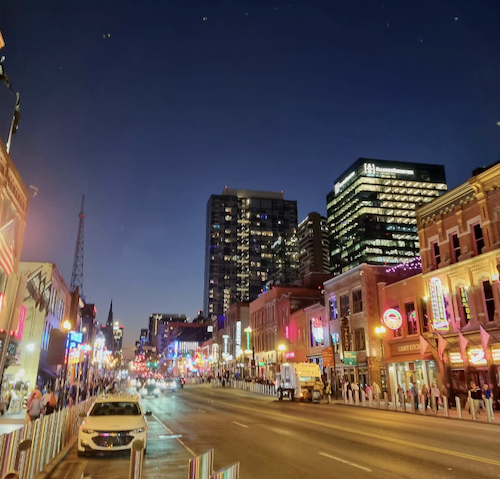
The oddest thing about that place: it's not there. The fog off the Cumberland River waterfront, rolling along Broadway and onwards to the Gulch, still swirls with ghosts. There are echoes of the Oz-like old town on Music Row, where hopefuls still dare to dream. But they have done such a job of razing the rotten that little of what you might wish to experience remains.
Bible Belt
It’s as though the buckle of the old Bible Belt has been bent out of recognition, its rusted prong stamped into earth and lost to time. Although Nashville remains a hub of religious organisations, establishments, publishing, education and Christian music, and is often referred to as ‘the Protestant Vatican’ thanks to its seven hundred-plus churches and many religious schools, universities and colleges, it resonates relentlessly around the world as Music City.
We hear its name and our thoughts maybe turn to Broadway. Our memories twinkle with stars. But Nashville’s Broadway has little in common with the New York theatre district’s Great White Way. While my music business executive elder daughter, who accompanied me, lapped it up and abandoned herself to it, I must admit to having found it a hellhole.
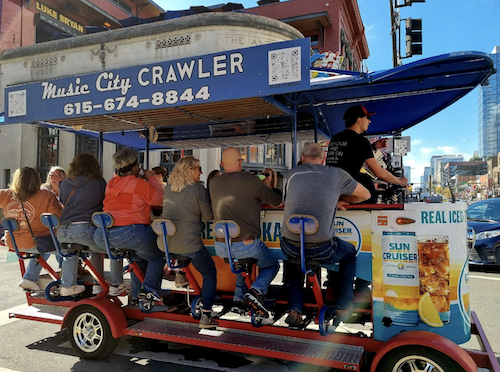
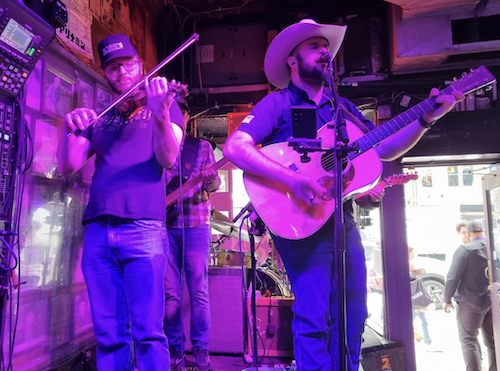
The monstrously overrun touristy downtown put me in mind of Hamburg’s St. Pauli district and the Reeperbahn: the seedy enclave where the pre-fame Beatles tightened their act and honed their chat in the early 1960s. Legions of drunken bachelors and bachelorettes, aka stags and hens, roam shit-stained streets in matching fancy dress. In Nashville, no prizes: it can only be cowboy boots and a Stetson or a ten-gallon hat. The strip is a cacophony of country music, honky tonks and in-your-face nightlife than kicks off at breakfast and raves through until dawn. Upbeat and downmarket.
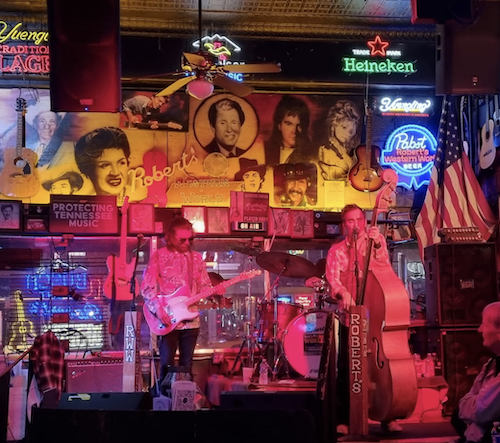
It is a blot on the landscape for Tennesseeans who have called the state capital home for all or most of their lives. Locals complain that they no longer feel safe there. Droves of thrill-seekers high on beer, Jack Daniel’s and moonshine and vomiting fried chicken and tacos stumble in and out of Robert’s, Tootsie’s and Kid Rock’s gaff, passing out and getting trodden into the sidewalk. Date-drugging and raping and dead beggars are all too common here. Everyone is laughing, but no one is joking.
Rhinestoned heritage
Some seethe that the past ten years have ruined a once glorious destination and its rhinestoned heritage. Who are they trying to kid? Music business friends and fellow writers remember Broadway and Printer’s Alley as no-go areas during the eighties and nineties, when they began hopping planes to frequent them. But contrary to a widely-held assumption, Nashville’s Broadway hadn’t always been disreputable.
In the way back, let’s go 1875, the main drag boasted the city’s first public high school. Its reputation as Honky Tonk Highway was moons away. The Alley, on the other hand, which had been akin to London’s Fleet Street during the early 1900s, and home to important newspapers such as the Tennessean and the Nashville Banner, took a turn when the casinos and the brothels crept in. After Prohibition – imposed in Nashville in 1909 and lifted in 1938 – some of those venues became the speakeasies frequented by notorious gangsters during the late 1940s.
While I am fond of pondering history whenever I go places, I try not to let the past cloud or confuse the now. A city is by definition a moveable feast. It ebbs and flows to the memories of all who were there before us, and to the rhythms of those who arrive and those who leave. It is necessarily in a constant state of flux, reflective of human activity, dreams and need. In common with most metropolises on the planet, all who land in Nashville are looking for something. Some find it and stay. The majority who never find it find it hard to tear themselves away.
Under your skin
A city gets under your skin. It chafes at your veins, slips into your blood, demands more of you than you are able or want to give. We who land for a moment, for a reason – to say we’ve been, to partake of an experience, to see and wonder, to learn, to understand or simply to broaden our horizons a little – never get to get away unscathed.
You don’t think so? Consider the songs. Tony Bennett left his heart in San Francisco – or should I say the writers George Cory and Douglass Cross did. They actually penned the number not for the crooner who made it his signature, but for the operatic contralto Claramae Turner, who appeared in the 1956 film Carousel.
‘I’m Gonna Be (500 Miles) by the Proclaimers is an ode to Scotland. John Denver’s ‘Take Me Home, Country Road’ eulogises West Virginia – where life is old, older than the trees. But it was actually inspired by a back road in Gaithesburg, Maryland. At the time of writing, Denver and his co-conspirators had never yet set foot in the Mountain State. As for ‘New York, New York’: the song synonymous with Sinatra since 1979 was written by John Kander and Fred Ebb for the eponymous Martin Scorsese film starring Liza Minnelli. They always say it’s a nice place to visit, but I wouldn’t want to live there.
Carmichael and Stuart Gorrell created ‘Georgia on My Mind’ in 1930, but it’s Ray Charles’s voice singing it that we revere. He wasn’t serenading a longed-for woman but pining for his home state, thirty years after the song was coined. Another famous home-state-pining was conjured by Lynyrd Skynyrd, in ‘Sweet Home Alabama’.
And was Billy Joel longing for the Austrian capital when he came up with ‘Vienna’ (on his album
The Stranger, and the B side of ‘Just the Way You Are')? It seems unlikely. ‘New York State of Mind’, on the other hand … I can go for that. He later described ‘Vienna’ as ‘a metaphor for old age’, and as an acknowledgement that we have our whole lives to live, not just ‘now’. In other words, we who are inclined to fear that it’s all running out, there is time.
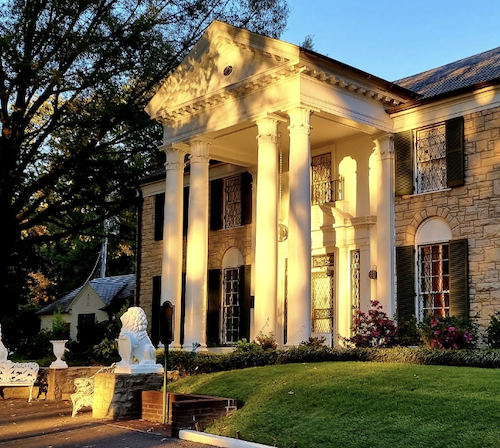
We could be here all week doing this, so I will mention for now just two more favourites: ‘California Dreamin’’ by the Mamas & the Papas – wishing to escape a shivering, brown-leaved, grey-skied New York for West Coast warmth; and Paul Simon’s ‘Graceland’, in which he makes his legendary pilgrimage to Elvis’s home in search of truth and redemption. But I am coming to that.
There are a host of songs about Nashville. Getting back to Macca, he referenced Printers Alley in the Wings song ‘Sally G’. Remember it as the B side of their 1974 single ‘Junior’s Farm’? But no, he didn’t play it this outing. He hasn’t performed it live for years. I wish he had.
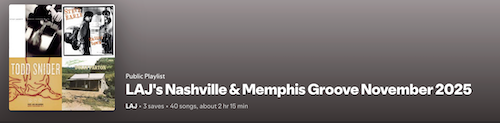
I made a playlist of tunes reflecting my Tennessee odyssey, which you can visit here:
Until next, when I’ll be walking in Memphis. On Beale Street, with my feet ten feet off the ground.